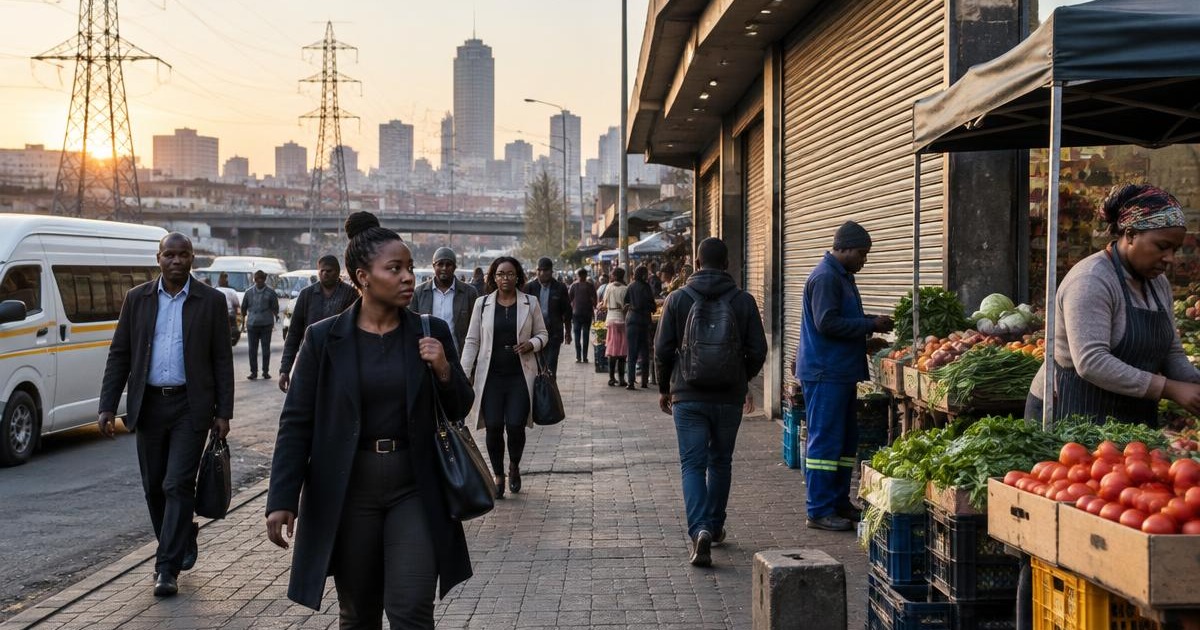
Current position (24 September 2026): South Africa is not in economic collapse, but years of weak growth have left the country unable to create enough jobs or improve living standards consistently. GDP contracted by 0.2% in the second quarter of 2026, official unemployment reached 33.6%, and government still spends roughly one rand in every five of its revenue on debt interest.
South Africans often describe the economy as “crippling” because the pressure is felt directly: too few jobs, expensive credit, rising household costs, failing local services and businesses that struggle to expand. The more precise diagnosis is a slow-growth economy under severe structural strain. Some national systems have improved, especially electricity generation, but those gains have not yet produced enough investment, jobs or income growth.
The short answer: what is going wrong?
South Africa's economic problem is not one single crisis. Several constraints reinforce one another:
- Economic growth has been too slow to keep pace with population growth
- Unemployment remains exceptionally high, especially among young people
- Rail, ports, water systems and many municipal services are unreliable
- Government debt absorbs money that could otherwise fund services and investment
- Weak education outcomes and skills mismatches exclude many people from available work
- Policy uncertainty, crime and administrative delays discourage investment
- Deep inequality means even modest national growth does not reach households evenly
These problems developed over many years. They cannot be fixed by one budget, one interest-rate decision or one quarter of better data.
Is South Africa's economy actually shrinking?
It depends on the period being measured. Statistics South Africa reported that real GDP contracted by 0.2% from the first to the second quarter of 2026, after seasonal adjustment. Compared with the second quarter of 2025, the economy was still 0.9% larger.
That is stagnation rather than outright collapse. However, growth below population growth means average living standards can continue to fall even when total GDP rises slightly. The World Bank says real income per person remains below its 2007 level after a long period of weak growth.
Forecasts are not facts. Before the latest quarterly contraction was known, National Treasury forecast 1.6% growth for 2026, while the IMF projected 1.4%. Both depend on reforms continuing and global conditions not deteriorating.
Unemployment is the central emergency
The official unemployment rate rose to 33.6% in the second quarter of 2026. About 8.5 million people were unemployed under the official definition. The expanded rate, which also includes discouraged work-seekers, was 43.8%.
High unemployment weakens the whole economy. Fewer earners support more dependants, the tax base remains narrow, households borrow to cover essentials, and businesses face weak consumer demand. Young people who spend years outside work also lose experience and professional networks, making later entry harder.
Unemployment is not simply a result of people lacking effort. It reflects weak demand, unequal schooling, spatial separation from jobs, expensive transport, limited work experience and an economy that has not produced enough entry-level opportunities.
Why households feel poorer
An inflation rate can slow while prices remain high. Slower inflation means prices are increasing more slowly; it does not mean groceries, transport or electricity return to earlier prices.
For households, the pressure usually comes from several directions at once:
- Food, electricity, transport and municipal charges take a larger share of income
- High interest rates increase home-loan, vehicle and other variable-rate repayments
- Unemployment forces one salary or grant to support several people
- Service failures create private costs for water, power, security and transport
- Wage increases may not keep pace with the cost of essentials
National averages also hide inequality. A period that feels manageable to a household with savings and stable work can be devastating to one with irregular income and debt.
Government debt limits the room to respond
National Treasury projected gross government debt to peak at 78.9% of GDP in 2025/26. More importantly for the annual budget, debt-service costs absorb about 21% of government revenue — roughly one rand in every five.
Interest payments protect South Africa's ability to borrow, but they leave less room for schools, policing, healthcare, infrastructure and targeted support. Cutting debt too quickly can also damage services and growth. The practical challenge is therefore to stabilise debt while spending better, reducing waste and directing scarce funds towards investments that improve productivity.
Debt is high, but “bankruptcy” is not an accurate description. Treasury projects the debt ratio to stabilise and gradually decline if revenue and spending plans hold. That outcome is a projection and depends on disciplined budgets and stronger growth.
Electricity has improved — so why is growth still weak?
The electricity picture is materially better than during the severe load-shedding years. Eskom reported 490 consecutive days without scheduled national load-shedding by 22 September 2026, with stronger plant performance and lower diesel use.
This is an important economic gain, but electricity generation was only one constraint. Local distribution networks still fail, some areas face load reduction, and businesses continue to absorb the cost of backup systems. Rail, ports, water, municipal administration, crime, skills shortages and weak demand can still prevent a firm from expanding even when the national grid is stable.
The improvement should therefore be recognised without pretending that the wider economy has already recovered.
Rail, ports and municipalities still hold businesses back
South Africa is far from major export markets, so reliable freight rail and ports are essential. Transnet has reported improving volumes and returned to annual profit, but its large maintenance backlog, debt, theft and operational problems still increase the cost of exporting minerals, agricultural goods and manufactured products.
At local level, water interruptions, sewage failures, poor roads, billing problems and slow approvals affect households and firms. The Auditor-General continues to report widespread weaknesses in municipal financial management. When a business must provide its own water storage, electricity backup, security and road access, the cost of operating rises and fewer projects remain viable.
Inequality makes every shock more damaging
South Africa remains one of the world's most unequal societies. Apartheid's spatial and educational legacy still shapes where people live, the schools they attend, transport costs, inherited wealth and access to professional networks.
This means growth alone is not enough. The type of growth matters. Labour-intensive industries, reliable public transport, better basic education, apprenticeships, small-business access to markets and effective local services can spread opportunity more widely than growth concentrated in a few capital-intensive sectors.
Are economic reforms working?
There is measurable progress, but it is uneven. Operation Vulindlela has advanced private electricity generation, transmission planning, visa reform and private participation in freight logistics. Eskom's generation recovery and Transnet's improved results show that failing systems can change.
The slower areas are equally important: municipal recovery, water infrastructure, housing, basic education and the speed of public administration. The IMF warns that reform fatigue and global trade uncertainty remain risks. Announcing a reform is not the same as implementing it, and implementation is not complete until households and businesses experience a reliable service.
What would a durable recovery require?
No single policy can turn the economy around. A credible recovery would need sustained action across several fronts:
- Keep electricity supply reliable and expand the transmission grid
- Restore rail and port performance so exporters can compete
- Repair water systems and intervene earlier in failing municipalities
- Improve basic literacy, numeracy, technical training and pathways into first jobs
- Make it easier for legitimate small businesses to register, trade and hire
- Prosecute corruption and improve procurement rather than only adding new controls
- Stabilise public debt while protecting productive infrastructure and essential services
- Provide predictable rules that encourage long-term local and foreign investment
Success should be judged by outcomes: rising real income per person, sustained job creation, higher investment and reliable public services — not only by plans, announcements or one positive quarter.
What this means for ordinary South Africans
The economy is likely to remain difficult even when individual indicators improve. Households should treat dramatic claims carefully: a stronger rand does not immediately reduce unemployment, the end of national load-shedding does not repair municipal grids, and a quarterly contraction does not by itself prove national collapse.
Use official data to separate three things: what has already happened, what government or economists forecast, and what a commentator believes should happen. That distinction makes economic news easier to understand and misinformation easier to spot.
Sources and further reading
- Statistics South Africa: GDP, second quarter 2026
- Statistics South Africa: Quarterly Labour Force Survey, second quarter 2026
- National Treasury: 2026 Budget Review
- IMF: 2025 Article IV consultation with South Africa, February 2026
- World Bank: South Africa Macro Poverty Outlook
- Eskom: power-system update, September 2026
- Operation Vulindlela: economic reform progress report
- Auditor-General: local government audit outcomes 2024/25
Important: Economic statistics are revised and forecasts change. This independent explainer is general information, not financial or investment advice. Check the date and original source before relying on a figure.