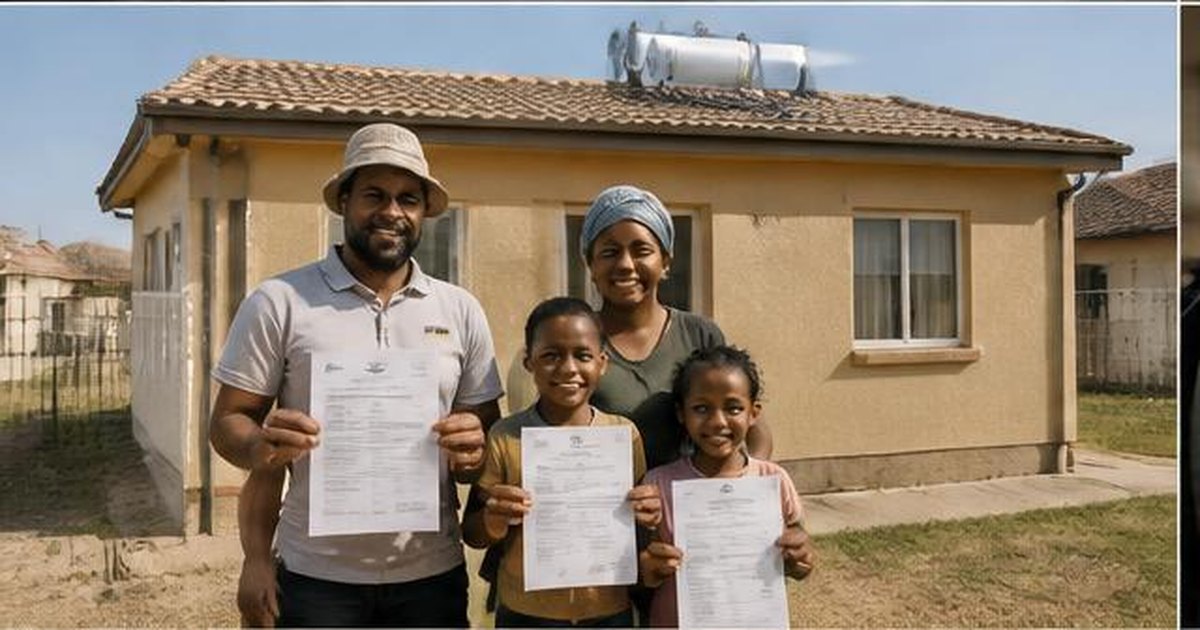
How to Apply for RDP/Free Government Housing
Since 1994, South Africa's government has provided fully subsidised homes to qualifying low-income citizens through what's still commonly called "RDP housing," named after the original Reconstruction and Development Programme. The scheme has evolved since then and now falls under the National Housing Subsidy Scheme, administered by the national and provincial Departments of Human Settlements, but the core idea hasn't changed: if you qualify, the government builds and hands over a house to you at no cost. Here's exactly how the process works, from eligibility through to checking your application status.
Eligibility Requirements
To qualify for a fully subsidised government house, you generally need to meet all of the following criteria, drawn from the National Housing Subsidy Scheme's official qualification rules:
- Citizenship/residency — You must be a South African citizen, or hold permanent residence, and have a valid South African ID.
- Age and legal capacity — You must be 18 years or older and legally competent to sign a contract (this includes being legally married, legally divorced, or of sound mind and contractual capacity).
- Household/dependency status — You must be married, habitually cohabiting with a partner, or single with proven financial dependents. There are also specific categories for single military veterans and single aged persons without financial dependents.
- Household income — Your combined household income must be less than R3,500.01 per month. If you and your household earn more than this but still can't easily afford a home, you may fall into the "gap market" instead, where a different programme called FLISP (Finance Linked Individual Subsidy Programme) may apply, covering household incomes roughly between R3,501 and R22,000 per month.
- First-time recipient — Neither you nor your spouse may have previously received a government housing subsidy or benefited from any other state-funded or state-assisted housing programme.
- First-time homeowner — You must not currently own, or have previously owned, fixed residential property.
- Ability to sustain ownership — You'll generally need to show that you're able to maintain and sustain ownership of the property going forward.
Because allocation is managed at a provincial and municipal level, some additional local rules or documentation requirements can apply depending on where you live — always confirm the exact current criteria with your provincial Department of Human Settlements or local municipal housing office.
Step 1: Register on the National Housing Needs Register
Before you can be considered for a subsidised house, you need to be formally registered. Depending on your province or municipality, this database is referred to as the National Housing Needs Register or, in some areas, the Municipal Housing Demands Database — functionally, they serve the same purpose of capturing and tracking housing need.
To register:
- Visit your nearest provincial office of the Department of Human Settlements, or your local municipal housing office.
- Request a housing subsidy application form.
- Complete the form with your personal details, household information, income details, and information about your dependents.
- Submit the completed form along with your supporting documents (below).
There is no application fee for this process — it is completely free, and anyone asking you to pay to register or to "speed up" your placement is attempting to defraud you.
Step 2: Gather Your Required Documents
Bring the following to your appointment, and be ready to certify copies at a police station or magistrate's court where required:
- A certified copy of your South African ID (and your spouse's or partner's ID, if applicable)
- Proof of income — a recent payslip if you're employed, or an affidavit confirming your unemployment status if you're not
- Birth certificates of all dependent children who will form part of the household
- Proof of residence in your current area
- Marriage certificate, if you're married, or divorce documentation, if applicable
- An affidavit, where an extended family member is being included as a dependent, confirming the relationship and their dependency on you
Accuracy matters here more than people expect — incomplete details, missing documents, or unclear information about dependents are among the most common reasons applications are delayed or disqualified further down the line. Take the time to get every document right before submitting.
Step 3: Completing the C-Form (Proof of Registration)
Once your application form and documents are accepted and you're successfully entered onto the housing register, you'll be issued a Form C — sometimes referred to as the C-form or proof of registration.
This form records your application number and the date you registered, and it's genuinely important to keep safe: it's the specific reference you'll need any time you want to check your status, follow up with a housing official, or query your position on the waiting list. Losing it doesn't remove you from the register, but it makes verifying and tracking your own application considerably harder, since offices will need to search for your details manually rather than pulling them up instantly from your reference number.
Step 4: Wait — and Understand How the Waiting List Works
Once registered, you're placed on a waiting list for your area. This is where the process is most often misunderstood: the waiting list is not centrally managed on a single national queue with one uniform waiting time. It's driven locally, meaning the wait varies significantly by province, municipality, and even by specific housing project, depending on local demand, available land, infrastructure readiness, and the pace of government funding allocated to that area in a given year.
There's no fixed, guaranteed timeframe for allocation, and it's not unusual for the process to take years. Some applicants have waited well over a decade, particularly in high-demand metro areas. This isn't a sign your application has failed — it reflects the scale of housing need relative to the houses actually being delivered each year.
Step 5: How to Check Your Application Status
Once you have your Form C reference details, you can check your status in a few ways:
- In person, at your nearest provincial Department of Human Settlements office or local municipal housing office — bring your Form C and ID.
- By phone, through your provincial department's housing enquiries line, or the National Housing Enquiries Hotline (0800 146 873).
- Online, in provinces or municipalities that offer a web-based status-check tool — availability varies, so check whether your specific province offers this option.
If you relocate to a different province or municipality after registering, check with your new local office whether you need to re-register there — a registration in one area doesn't automatically transfer your position on a different area's waiting list.
What Happens Once You're Allocated a House
If your application is approved and a house becomes available for you, you'll be asked to sign what's informally called a "happy letter" — a formal acceptance of the allocated property. National policy sets a minimum size of 40m² for a subsidised house, though some provinces (Free State, for example) have set a higher local minimum. Importantly, beneficiaries generally only receive the Title Deed to the property after eight years of occupation, not immediately upon handover — this is a standard feature of the scheme, designed in part to discourage immediate resale of subsidised properties.
FAQ
What does RDP housing actually mean today? "RDP house" is the common name people still use for a fully subsidised government house, referring back to the original 1994 Reconstruction and Development Programme. The scheme is now formally run under the National Housing Subsidy Scheme, administered by national and provincial Departments of Human Settlements.
What is the income limit to qualify? Combined household income must be less than R3,500.01 per month. If your household earns more than this — up to around R22,000 per month — you may instead qualify for FLISP, a separate subsidy programme aimed at first-time buyers who earn too much for a free house but still struggle to access home finance.
What is the minimum age to apply? 18 years old, and you must be legally competent to sign a contract — this includes being legally married, legally divorced, or otherwise of sound mind and contractual capacity.
Can a single person without children apply? Yes, in specific categories — single applicants with proven financial dependents can apply, and there are also dedicated categories for single military veterans and single aged persons without financial dependents. A single person with no dependents and none of these special categories generally would not qualify under the standard criteria.
What is the National Housing Needs Register? It's the official database used to capture and track housing need, sometimes called the Municipal Housing Demands Database depending on your area. Registering on it is the essential first formal step toward being considered for a subsidised house.
What is Form C, and why does it matter? It's your proof of registration on the housing register, showing your application number and registration date. You'll need it any time you want to check your status or follow up on your application, so keep it in a safe, memorable place.
How long is the waiting list, and when will I get a house? There's no fixed national timeframe — waiting periods are determined locally and vary significantly by province, municipality, and specific housing project. Waits of many years, sometimes over a decade, are not unusual in high-demand areas.
Does applying cost anything? No. Registration and the entire application process are completely free. Never pay anyone who claims they can register you, expedite your placement, or guarantee you a house for a fee — this is a scam, and legitimate officials will never ask for payment.
Can I apply if I already received a housing subsidy or previously owned property? No. You must be a first-time recipient of a government housing subsidy and a first-time homeowner. Neither you nor your spouse can have previously benefited from this or any other state-funded housing programme.
What if I move to a different area after registering? Check with your new local municipal housing office or provincial Department of Human Settlements whether you need to re-register there, since your position on one area's waiting list generally doesn't transfer automatically to another area.
Do I get the Title Deed immediately when I move into an allocated house? No. Beneficiaries typically only receive the Title Deed after eight years of occupying the property, even though you take occupation and sign an acceptance ("happy letter") much earlier.
Who do I contact if I have questions or want to follow up on my application? Your nearest provincial Department of Human Settlements office, your local municipal housing office, or the National Housing Enquiries Hotline on 0800 146 873.
Sources
- Housing Act 107 of 1997
- National Housing Subsidy Scheme, qualification criteria — KwaZulu-Natal Department of Human Settlements FAQ (kzndhs.gov.za)
- Department of Human Settlements, Mpumalanga — FAQ (dhs.mpg.gov.za)
- City of Ekurhuleni, "Everything You Need To Know About Government Housing Subsidy (RDP)"
- Free State Department of Human Settlements, FAQ (humansettlements.fs.gov.za)
- National Housing Enquiries Hotline: 0800 146 873
This article is for general informational purposes and does not constitute legal advice. Eligibility criteria, required documents, and waiting list processes are administered provincially and can vary by location — confirm current requirements with your local municipal housing office or provincial Department of Human Settlements before applying.