South Africa's November 2026 local election results: who won?
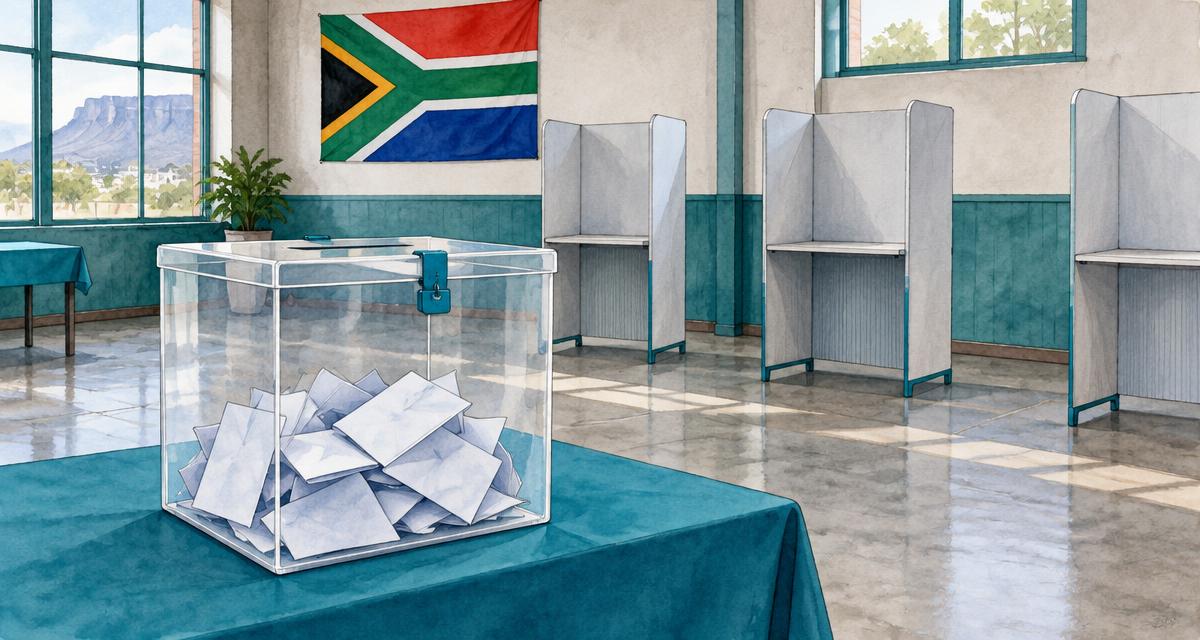
Checked on 11 November 2026. This report uses the Electoral Commission's declaration published by the South African government on 8 November. It is a dated explanation, not a live results service. The illustration above is an editorial illustration, not a photograph of voting day.
The short answer: the ANC led nationally, but there is no single municipal winner
The African National Congress (ANC) received the largest national share of the municipal vote: 30.89%, followed by the Democratic Alliance (DA) on 24.60%. The election took place on Wednesday, 4 November 2026, and the IEC declared the elections free and fair on Sunday, 8 November 2026. These are the figures in the official declaration, not campaign claims or earlier counting-day projections. 1
However, saying that one party “won South Africa” would be misleading. Local elections elect municipal councils, not a president or a National Assembly. A party can receive the most votes nationally and still lack enough seats to govern a particular municipality alone. The useful question for residents is: who has the seats to govern my council, and has its leadership actually been elected?
The declared national party results
The following figures are quoted from the IEC chairperson's 8 November declaration. Seats are council seats across municipalities, not seats in Parliament. National vote percentages do not decide control of every council. 1
| Party | National vote share reported | Council seats reported |
|---|---|---|
| African National Congress (ANC) | 30.89% | 3,164 |
| Democratic Alliance (DA) | 24.60% | 1,527 |
| uMkhonto weSizwe Party (MK Party) | 9.61% | 701 |
| Economic Freedom Fighters (EFF) | 6.25% | 505 |
| ActionSA | 5.68% | 219 |
The declaration groups all other parties and independent candidates together at 22.97% of the vote. This table reproduces the five parties listed in that speech; it is not a complete list of parties or a substitute for detailed municipal results. Rounded percentages can differ slightly from 100% when added together.
Who secured outright municipal control?
The IEC declaration reports the following outright-control and leading-party figures. “Leading” is not a promise that a party will form the administration. Do not add the two columns together: they describe different measures, not two separate sets of victories. 1
| Party or local organisation | Municipalities with outright control reported | Municipalities where it leads reported |
|---|---|---|
| ANC | 51 | 120 |
| DA | 12 | 29 |
| Inkatha Freedom Party (IFP) | 5 | 19 |
| MK Party | 3 | 18 |
| Rise Tsantsabane Communities | 1 | Not specified in the declaration |
This explains why two apparently conflicting headlines can both need qualification: the ANC was the largest party nationally, while another party may have secured outright control in your municipality. Where no party has an outright majority, council leadership depends on how elected councillors vote and whether parties reach agreements.
A source inconsistency matters here. The published declaration says there are 213 municipalities, 72 outright-majority councils and 127 hung councils. The last two figures add up to 199, not 213. We therefore do not present those numbers as a reconciled nationwide council breakdown or invent an explanation for the difference. For an individual municipality, use the IEC's detailed results reports. This does not change what the speech reports for each party above, but it limits the conclusions that can responsibly be drawn from its council totals.
The latest political issue: forming municipal administrations
Following the declaration, the immediate political question is how councils without an outright majority will choose leadership and form administrations. Reporting on 9 November described parties seeking coalition partners. That reporting establishes that negotiations were under way; it does not confirm the final coalition or mayor in every municipality as of 11 November. 4
A coalition is an agreement between parties to work together. Parties may also support a leadership vote without entering a full coalition. The important distinction is between a party announcing what it wants, parties announcing an agreement, and a council formally electing its leadership. Those are separate events. A proposed deal is not the same thing as a confirmed mayor.
This article does not name unverified metro winners or claim that a new governing arrangement has been finalised. Johannesburg, Tshwane, eThekwini and every other municipality should be checked separately through official results and subsequent council notices. Do not apply the national percentages in the table to your own ward or metro.
Turnout, election integrity and the outstanding revote
In the chairperson's declaration, the IEC reported 52% national turnout, compared with 45.9% in 2021: an increase of 6.1 percentage points. It described approximately 29.2 million registered voters and 14.9 million people voting. These are approximate figures as stated in that speech, not new calculations made by this website. 1
The declaration also identifies an important exception: ballot papers at Jabulani Community Hall in ward 3 of Siyancuma Municipality, Northern Cape, were destroyed before counting. The IEC said a revote would be organised at that voting district. The speech did not supply a revote date. Residents affected should check a subsequent IEC notice rather than assume the matter is complete.
“Free and fair” is the IEC's assessment of the election. It does not mean that no incident occurred or that no objection can be considered. The declaration itself acknowledges the Siyancuma incident and continuing consideration of objections. Avoid treating either an allegation or a party's rejection of results as proof that an official result has been overturned.
What this election changes — and what it does not
Municipal councils make decisions that affect local budgets, infrastructure and municipal services. The practical test of an incoming administration is not only its party label, but whether it can pass budgets, oversee spending and improve delivery. Water interruptions, refuse collection, local roads and billing disputes remain issues residents should raise through the responsible municipality.
The election did not elect a new South African president or replace Parliament. National, provincial and municipal elections concern different institutions. For background, read our explanation of provincial and national elections and how South African elections work.
An election result is not an immediate guarantee that a service problem will be resolved. Keep reporting faults, keep reference numbers, and check the municipality's notices about councillors and council meetings. Our municipal service-problem guide explains how to build a written record and follow up.
How to check who won in your municipality
- Open the official IEC election results home and select the 2026 local government election dashboard or downloadable reports.
- Select your province and municipality. If you want your local representative, also check the ward contest rather than only a party's national total.
- Read the seat allocation, not just the percentage of votes. Councils contain both ward and proportional-representation councillors; outside metros, district representation adds another layer.
- Check whether the result is declared and whether an IEC notice affects your voting district. The Siyancuma revote is a reason not to assume every local issue is settled.
- Use your municipality's official council notices to confirm the elected mayor, speaker and any announced administration. An IEC result shows electoral representation; it does not by itself certify a subsequent coalition agreement.
The IEC results home links both dashboards and downloadable reports. A dashboard may depend on JavaScript and can show a loading screen; a blank or loading table is not evidence of zero votes. Use the available reports if the dashboard does not render. 3
Sources and reporting limits
- Primary results source: IEC chairperson's official declaration, 8 November 2026. All party percentages, seats and control counts above are attributed to this specific text.
- Election date: IEC 2026 election timetable announcement, confirming Wednesday, 4 November 2026. 2
- Local verification: IEC results and downloadable reports. This article does not claim to have checked every municipal report.
- Political context: The Citizen's 9 November report on coalition negotiations, used for the negotiations context, not as a substitute for official election results.
Plain English SA Forms is independent of the IEC and all political parties. This is factual civic information, not an endorsement of a party. It is a snapshot checked on 11 November 2026; subsequent revotes, corrections, council meetings or coalition changes require fresh verification.