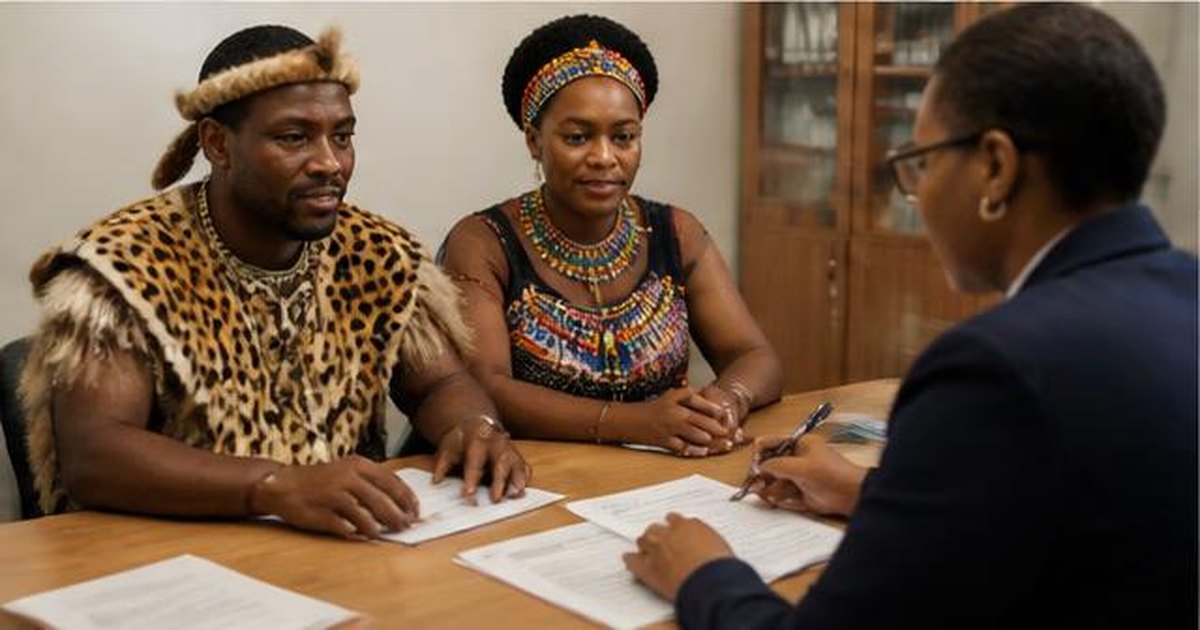
How to Register a Customary Marriage in South Africa
A customary marriage — one negotiated, celebrated, or concluded according to African customary law — is fully recognised as a legal marriage in South Africa under the Recognition of Customary Marriages Act 120 of 1998. But recognition and registration are not the same thing. This plain-English guide explains who the Act covers, why registering matters, what to bring to Home Affairs, and what happens to property and children.
Quick facts
Quick facts
- Law: Recognition of Customary Marriages Act 120 of 1998
- Valid even unregistered: Yes — registration does not create the marriage, it proves it
- Deadline: The Act says register within 3 months, but there is no penalty for registering later
- Cost: Free
- Where: Any Department of Home Affairs office
Is my customary marriage valid without registration?
Yes. A customary marriage entered into after 15 November 2000 is valid if both partners were 18 or older, both consented freely, and the marriage was negotiated and celebrated according to customary law — typically including lobolo negotiations between the families. You do not need a certificate for the marriage to exist in law.
However, without a marriage certificate you may struggle to prove the marriage exists when it matters most: when a spouse dies, when you claim from a pension fund or insurance policy, when you apply for a spouse's estate, or when you divorce. Registration is the practical proof, and it is free — so do it.
Who can register, and who must be present
Either spouse (or both together) can report the marriage for registration. You will need to attend a Home Affairs office in person. If your spouse cannot come along, you can still register the marriage yourself, but bring as much supporting information as possible, including the details of the lobolo agreement.
Both partners must be South African citizens or permanent residents for the standard process. If one partner is a foreign national, Home Affairs may require an interview and additional documentation before registering.
Documents you need
Take the following to any Home Affairs office:
- Your Smart ID card or green barcoded ID book
- Your spouse's ID (original or certified copy)
- A completed Form BI-1699 (the customary marriage registration form, available at the office)
- A copy of the lobolo agreement or lobolo letter, if one exists
- If the lobolo letter is missing: an affidavit by the families or the traditional leader who presided, confirming the marriage took place
- If one partner is deceased or cannot attend: a death certificate or an affidavit explaining the circumstances
Step by step at Home Affairs
- Collect and complete Form BI-1699 at the office, or download it from dha.gov.za beforehand.
- Hand in the form and your documents to the Home Affairs official.
- Both spouses' fingerprints are taken where both are present.
- The marriage is captured on the National Population Register.
- Receive your marriage certificate — Home Affairs issues a certificate confirming the customary marriage. Processing of the formal certificate can take some weeks, but you should receive confirmation that registration was captured.
Property: are you married in or out of community of property?
This is the part most couples miss:
- Customary marriages concluded after 15 November 2000 are automatically in community of property, unless the couple signed an antenuptial contract before the marriage.
- Marriages concluded before that date were historically treated as out of community of property, but the Constitutional Court has extended in-community-of-property protection to many of these marriages — get legal advice if yours is an older marriage.
- If you want to change your matrimonial property system after the marriage, both spouses must apply to the High Court together.
Polygynous marriages
The Act recognises polygynous customary marriages. A husband who wants to take a further wife must apply to the High Court to approve a written contract regulating the property of the marriages. Register each marriage with Home Affairs in the same way as above.
What if my spouse refuses to register?
Registration does not depend on your spouse's cooperation. One spouse alone can report the marriage with supporting evidence (the lobolo letter, affidavits from the families or the traditional leader, photographs of the ceremony, witness statements). Home Affairs may investigate or ask both parties to confirm, but a refusal to attend does not make the marriage invalid.
Dissolving a customary marriage
A customary marriage can only be ended by a decree of divorce from a court — the same as a civil marriage. There is no customary "return of lobolo" that legally ends the marriage. Until a court grants a divorce, both spouses remain legally married, with all the property and maintenance consequences that follow.
Frequently asked questions
Is lobolo the same as a customary marriage? Lobolo is part of the customary process, but the marriage exists through the negotiations and celebration according to custom. A lobolo letter on its own is not a marriage certificate — register the marriage at Home Affairs for legal proof.
Can I be married civilly and customarily to the same person? Yes, to the same person — but the civil marriage converts the property regime, and you cannot later enter another customary marriage with someone else while the civil marriage stands.
Can I register a customary marriage if my spouse has died? Yes. You can register posthumously with the death certificate and evidence such as the lobolo letter or affidavits from the families. This is essential for claiming from the estate or a pension fund.
How much does registration cost? Registering a customary marriage and the certificate issued at registration are free of charge at Home Affairs.
Do children of a customary marriage have the same rights? Yes. Children born of a customary marriage are fully legitimate in law, with the same rights as children of a civil marriage.
What if Home Affairs cannot find our lobolo letter? Ask the family representatives or the traditional leader who presided to make affidavits confirming the marriage. Home Affairs accepts these as supporting evidence.
Sources
- Recognition of Customary Marriages Act 120 of 1998 (gov.za)
- Department of Home Affairs — Marriage certificates (dha.gov.za)
- Department of Justice — Customary marriages (justice.gov.za)
This guide is general information, not legal advice. For disputes about property, divorce, or estates arising from a customary marriage, consult an attorney or Legal Aid South Africa.